
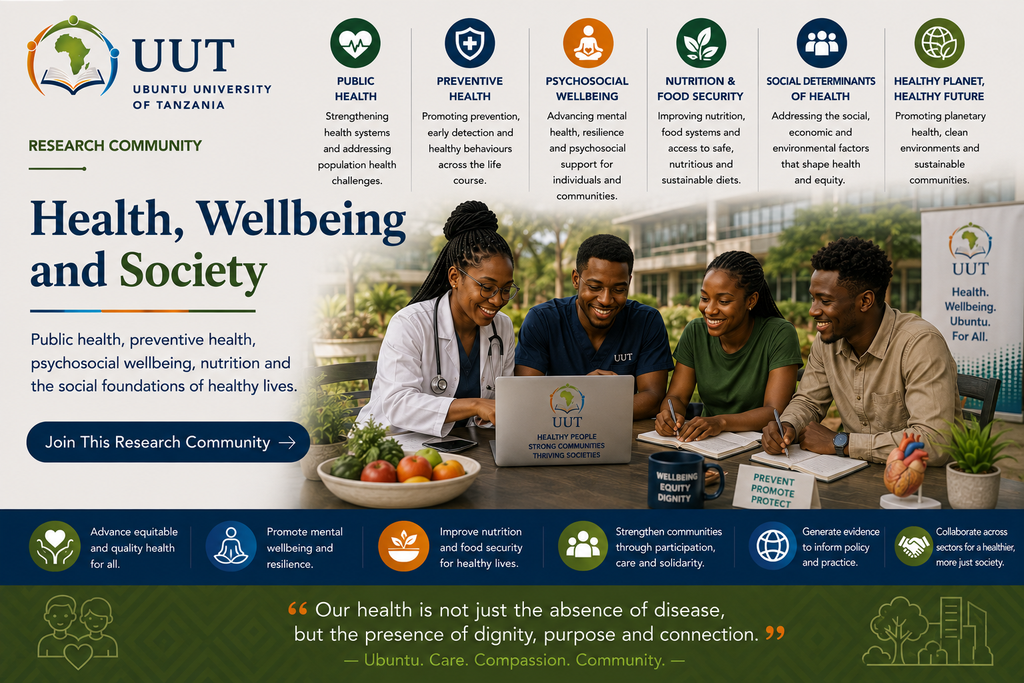
Rethinking Health as a Foundation for Human Flourishing
Health is more than the absence of disease. It is shaped by the conditions in which people are born, grow, learn, work, form relationships and participate in society. Economic security, education, nutrition, housing, culture, environment, social relationships and access to appropriate services all influence people’s capacity to live healthy and meaningful lives.
The Health, Wellbeing & Society Research Community at Ubuntu University of Tanzania (UUT) brings together researchers, postgraduate students, health professionals, communities, policymakers and institutional partners interested in understanding the interconnected social, relational, institutional and developmental dimensions of health and wellbeing.
Rooted in African realities and engaging global scholarship, the community seeks to generate knowledge that contributes not only to longer lives, but to healthier individuals, stronger communities and societies in which people have meaningful opportunities to flourish.
The Question That Matters
How can African societies create the conditions in which people and communities can live healthy, meaningful and flourishing lives?
This question recognises that health outcomes cannot be explained solely through individual behaviour or healthcare provision. They emerge within broader social systems and are affected by poverty and inequality, work, family and community relationships, public institutions, environmental conditions and access to resources.
The community therefore approaches health and wellbeing as simultaneously personal, relational and societal.
Our Research Focus
The community encourages theoretical, empirical and applied research in areas including:
- Health and human flourishing — investigating relationships among physical health, psychological wellbeing, meaning, relationships, agency and quality of life.
- Social determinants of health — examining how income, education, employment, housing, food security, gender, geography and other social conditions influence health.
- Mental health and psychosocial wellbeing — exploring mental distress, resilience, belonging, meaning, social support and culturally responsive approaches to wellbeing.
- Community and public health — investigating community-based approaches to prevention, health promotion and population wellbeing.
- Health systems and governance — examining accessibility, quality, equity, institutional capacity and governance of health services.
- Work, organisations and wellbeing — investigating burnout, workplace pressure, organisational culture, leadership, work-life relationships and sustainable working environments.
- Maternal, child, youth and family wellbeing — examining health and wellbeing across critical stages of life and within family and community relationships.
- Nutrition, food and health — exploring relationships among food systems, nutrition, lifestyle and human wellbeing.
- Digital health and emerging technologies — examining opportunities and ethical challenges associated with digital health, data and artificial intelligence.
- Culture, indigenous knowledge and health — investigating African understandings of health, healing and wellbeing and their relationships with contemporary health systems.
From Healthcare to the Conditions for Health
Healthcare systems are indispensable, but societies cannot achieve health through healthcare alone.
Many conditions that eventually appear within clinics and hospitals originate elsewhere—in homes, schools, workplaces, communities, economies and environments. Preventing illness and advancing wellbeing therefore requires attention to these wider determinants.
The community encourages research that moves across conventional boundaries between health, development, education, economics, psychology, sociology, governance and environmental studies.
This interdisciplinary perspective makes it possible to ask not only how illness can be treated, but how societies can create conditions that enable people to remain well.
An Ubuntu Orientation
Ubuntu provides a particularly important perspective on health because it challenges excessively individualistic understandings of wellbeing.
Human beings flourish through relationships. Family support, belonging, dignity, social recognition, community, meaningful work and relationships of care can profoundly influence wellbeing.
An Ubuntu orientation therefore asks:
What if health were understood not only as an individual condition, but also as a quality of the relationships and social environments within which people live?
This perspective encourages research into the relational foundations of wellbeing while recognising that communities themselves can contain inequalities and practices requiring critical examination.
Ubuntu therefore provides an intellectual orientation rather than a romanticisation of community: healthy relationships should enhance dignity, agency, care, reciprocity and shared flourishing.
African Knowledge and Health
African societies possess diverse traditions of understanding health, illness, healing, community and the relationship between physical, social and spiritual wellbeing.
The Research Community encourages rigorous engagement with these knowledge traditions alongside biomedical, public-health and social-scientific approaches.
Such engagement creates possibilities for investigating culturally meaningful and scientifically responsible approaches to health while contributing to wider debates about knowledge pluralism, traditional medicine, health systems and epistemic justice.
Research, Policy and Practice
The community seeks scholarship capable of contributing to policy and practice as well as academic knowledge. Its work may inform public-health policy, health-system strengthening, workplace wellbeing, community interventions, mental-health strategies and programmes addressing social determinants of health.
Activities may include postgraduate research, interdisciplinary projects, community-engaged research, seminars, policy dialogues, working papers, scholarly publications and partnerships with health institutions, communities, universities, governments and development organisations.
Join the Research Community
UUT welcomes researchers, postgraduate students, health professionals, psychologists, social scientists, policymakers, community organisations and institutional partners interested in advancing research on Health, Wellbeing & Society.
Through interdisciplinary and relational inquiry, the community seeks to contribute to an Africa in which health is understood not merely as survival or freedom from illness, but as part of the wider possibility for people, communities and societies to flourish.