
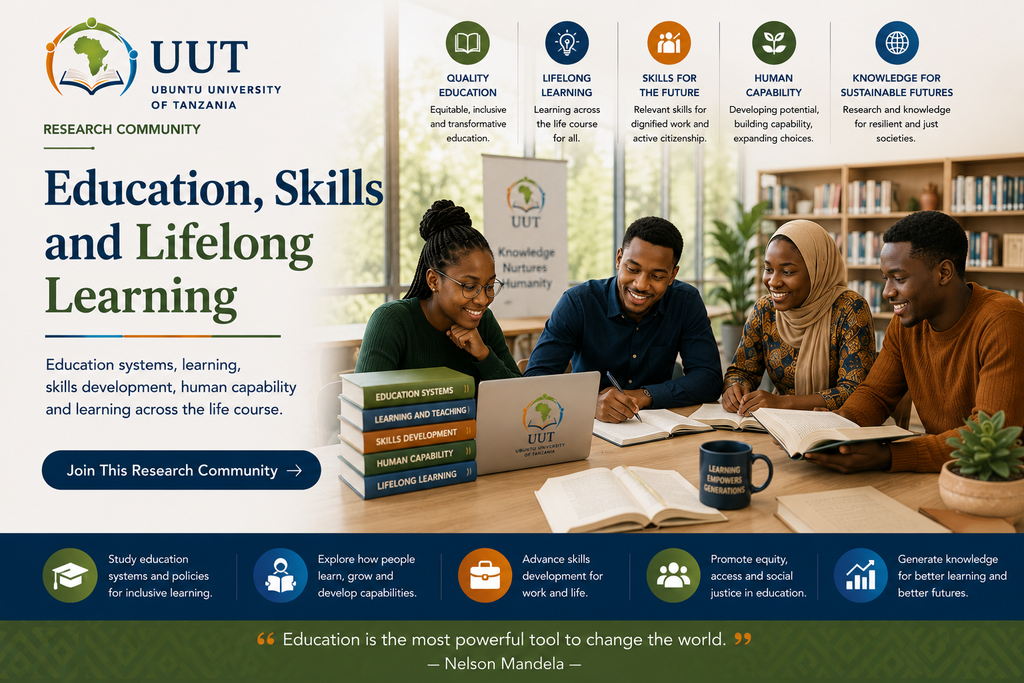
Developing Human Capabilities Across the Life Course
Education is more than preparation for employment. It is a lifelong process through which people develop knowledge, capabilities, values and agency to participate meaningfully in society and pursue lives they have reason to value.
The Education, Skills & Lifelong Learning Research Community at Ubuntu University of Tanzania (UUT) brings together researchers, postgraduate students, educators, policymakers, practitioners and partners interested in understanding how education and learning can contribute to human flourishing, social transformation and sustainable development.
Rooted in African realities while engaging global scholarship, the community examines education across the life course—from early learning and schooling to higher education, professional development, workplace learning and learning throughout adulthood.
The Question That Matters
How can education develop human capabilities, strengthen societies and enable people to flourish throughout life?
This overarching question recognises that educational systems face challenges extending well beyond access to schooling. Africa must simultaneously address learning quality, inequality, rapidly changing labour markets, technological transformation, teacher development, knowledge production and the continuing need to make education responsive to local communities and cultural contexts.
The Research Community provides an interdisciplinary space for investigating these challenges and developing educational possibilities appropriate to Africa’s changing social, economic and technological environment.
Our Research Focus
The community welcomes theoretical, empirical and applied research across interconnected areas including:
- Education and human flourishing — examining how education contributes to dignity, agency, wellbeing, meaning, relationships and the development of human capabilities.
- Teaching, learning and pedagogy — exploring effective, inclusive and contextually responsive approaches to teaching and learning.
- Teacher education and professional development — investigating teacher preparation, professional learning, educational practice and the changing role of educators.
- Skills and employability — examining relationships among education, capabilities, work, entrepreneurship and changing labour markets.
- Higher education and universities — investigating the purposes, governance, transformation and societal contribution of higher education in Africa.
- Digital learning and artificial intelligence — exploring opportunities, inequalities and ethical questions associated with emerging technologies in education.
- Indigenous knowledge and decolonial education — examining African knowledge traditions, epistemic justice, language and the continuing transformation of educational knowledge and institutions.
- Lifelong and community learning — investigating learning beyond formal educational institutions and across different stages of human life.
An Interdisciplinary Research Community
Educational questions rarely belong to education alone. Learning is shaped by families, communities, cultures, economies, technologies, institutions and public policy.
The community therefore encourages collaboration across education, development studies, psychology, sociology, economics, philosophy, technology, public policy and other relevant fields. It particularly welcomes research capable of connecting educational theory with the lived realities of learners, educators, institutions and communities.
An Ubuntu Orientation
Ubuntu provides an important intellectual and ethical orientation for this research community. It invites researchers to consider education not simply in terms of individual achievement, credentials or economic productivity, but also in terms of relationships, responsibility, belonging and shared human flourishing.
From this perspective, a fundamental educational question becomes not only What should a person know? but also What kind of person, relationships and society should education help to cultivate?
This orientation does not prescribe a single methodology or theoretical position. Rather, it opens a space for rigorous scholarly inquiry into educational systems that recognise both individual capabilities and the relational conditions through which people learn and flourish.
Research, Policy and Practice
The community seeks research that can contribute to both scholarship and practice. Its work may inform educational policy, curriculum development, teacher education, institutional transformation, community initiatives and innovations in teaching and learning.
Research activities may include individual and collaborative projects, postgraduate research, seminars, research dialogues, working papers, publications, conferences and partnerships with educational institutions, communities, governments and other organisations.
Join the Research Community
UUT welcomes scholars, postgraduate researchers, educators, policymakers, practitioners and institutional partners interested in contributing to research on Education, Skills & Lifelong Learning.
Through intellectual exchange and collaborative inquiry, the community seeks to develop knowledge that can help reimagine education for Africa and contribute to a future in which learning enables people and communities not merely to adapt to change, but to live, participate and flourish more fully.