
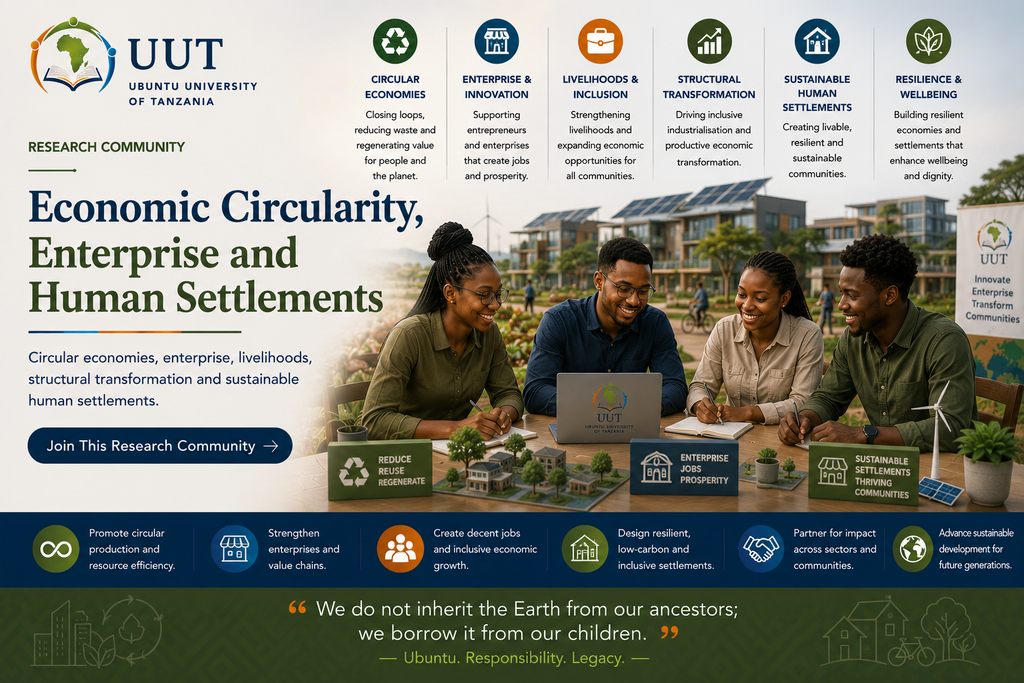
Transforming Economies, Livelihoods and the Places People Call Home
Africa’s development challenge is not simply to produce more, build more or consume more. It is to create economic systems that use resources responsibly, generate productive livelihoods, support innovative enterprises and enable people to live with dignity in resilient and sustainable communities.
The Economic Circularity, Enterprise & Human Settlements Research Community at Ubuntu University of Tanzania (UUT) brings together researchers, postgraduate students, entrepreneurs, communities, policymakers, practitioners and institutional partners interested in understanding how circular economies, enterprise development, livelihoods, structural transformation and human settlements can work together to advance sustainable human flourishing.
Rather than treating these as separate development concerns, the community investigates their interconnections. How resources are produced and reused affects enterprises. Enterprises shape employment and livelihoods. Productive livelihoods influence the wellbeing of households and communities. Economic transformation changes where and how people live. Human settlements, in turn, shape access to opportunities, services, infrastructure and quality of life.
The Question That Matters
How can circular economies, innovative enterprises and sustainable human settlements work together to create inclusive livelihoods, structural transformation and resilient communities in Africa?
This question recognises that sustainable development requires more than environmental protection or economic growth considered separately.
Africa needs economic transformation capable of creating decent livelihoods while reducing unnecessary resource depletion and waste. It needs enterprises that generate innovation, employment and prosperity. It also needs settlements in which people can access housing, infrastructure, economic opportunities and the conditions necessary for healthy and dignified lives.
The Research Community therefore examines these challenges as parts of an interconnected system.
Our Research Focus
The community is organised around six interconnected domains of inquiry.
Circular Economies
The community investigates how economic systems can move from predominantly linear models of extraction, consumption and disposal towards models that reduce waste, extend product life, recover resources and regenerate value.
Research may examine circular production, repair and reuse, recycling and resource recovery, sustainable consumption, regenerative systems, industrial symbiosis and policies that enable circular economic transitions.
Particular attention is given to how circularity can be developed within African economic realities, including informal economies, local production systems and community practices.
Enterprise & Innovation
Enterprises are critical engines of employment, innovation and economic transformation.
Research in this domain examines how entrepreneurship and enterprise development can create jobs, income, productive opportunities and sustainable prosperity. Areas of interest include small and medium enterprises, social enterprise, green entrepreneurship, innovation ecosystems, enterprise finance, technology, local value addition and sustainable business models.
The community is particularly interested in enterprises capable of combining commercial viability with positive social and environmental outcomes.
Livelihoods & Inclusion
Economic transformation matters ultimately because of what it enables people and communities to become and achieve.
This domain investigates how economic systems can strengthen livelihoods, reduce vulnerability and expand opportunities for meaningful participation in economic life. Research may address employment, informal livelihoods, poverty, inequality, youth and women’s economic participation, rural livelihoods, social protection and inclusive economic development.
The central concern is that economic transformation should not merely increase aggregate wealth but expand real opportunities for people to live dignified and flourishing lives.
Structural Transformation
Sustainable prosperity requires economies capable of increasing productivity, creating value and developing increasingly sophisticated productive capabilities.
This domain examines processes of industrialisation, productive diversification and economic transformation, including movement into higher-value activities, development of local and regional value chains, technological upgrading, infrastructure and institutional conditions for productive investment.
Research considers how African economies can transform their productive structures without reproducing environmentally destructive development pathways or leaving significant sections of society behind.
Sustainable Human Settlements
Economic life takes place somewhere. The quality and organisation of human settlements profoundly influence access to work, education, healthcare, markets, mobility, energy, water and social relationships.
This domain investigates how cities, towns, villages and emerging settlements can become liveable, inclusive, low-carbon and sustainable communities.
Research may address housing, urbanisation, spatial planning, mobility, infrastructure, informal settlements, renewable energy, water and sanitation, green spaces, community design and the relationship between settlements and local economic development.
The objective is not simply to construct buildings and infrastructure, but to understand how human settlements can become environments in which people and communities thrive.
Resilience & Wellbeing
Economic and settlement systems must be capable not only of functioning under favourable circumstances but also of adapting to shocks and long-term change.
This domain examines how households, enterprises, communities and settlements develop resilience in the face of economic, environmental, climatic and social pressures.
Research may investigate livelihood resilience, climate adaptation, community wellbeing, social cohesion, economic vulnerability, disaster preparedness and institutional capacity.
The community is particularly interested in resilience that does more than enable people to endure adversity. The longer-term objective is to create systems capable of supporting wellbeing, dignity and human flourishing.
Connecting the Six Domains
The distinctive contribution of this Research Community lies in connecting these six areas rather than studying them in isolation.
Circularity can generate new resources and economic opportunities. Enterprise and innovation can transform those opportunities into productive activity. Productive enterprises can strengthen livelihoods and inclusion. Expanding productive capabilities can contribute to structural transformation. Economic transformation must be embedded within sustainable human settlements where people actually live and work. Together, these systems can strengthen resilience and wellbeing.
The relationships are not necessarily linear. Changes in settlements, technologies, institutions, livelihoods or resource systems can influence every other component.
The community therefore encourages systems-oriented research capable of identifying relationships, trade-offs, feedback mechanisms and opportunities for mutually reinforcing transformation.
An Ubuntu Orientation
Ubuntu adds a fundamental question to debates about economies, enterprises and settlements:
What kinds of economic systems and human environments enable people to flourish together?
From an Ubuntu perspective, economies exist within relationships. Enterprises depend upon workers, consumers, communities and ecological resources. Livelihoods depend upon institutions and social networks. Settlements create spaces in which relationships, opportunities and inequalities are experienced every day.
Economic development therefore carries responsibilities extending beyond the generation of financial value.
The community encourages research attentive to human dignity, relational responsibility, inclusion, stewardship, reciprocity and intergenerational responsibility. Prosperity should strengthen rather than undermine the human and ecological relationships upon which future prosperity depends.
African Knowledge, Enterprise and Innovation
Africa already possesses extensive practices of repair, reuse, sharing, resource recovery, informal enterprise, community production and adaptation. At the same time, emerging technologies, renewable energy, digital systems, new business models and changing patterns of urbanisation are creating new developmental possibilities.
The Research Community seeks to bring these worlds into productive conversation.
Rather than assuming that Africa must simply reproduce models of industrialisation and urbanisation developed elsewhere, the community encourages research into distinctively African pathways towards circularity, enterprise development and sustainable human settlements.
This includes serious engagement with indigenous and community knowledge alongside contemporary science, technology, economics, planning and innovation.
Research, Policy and Practice
The community seeks to connect scholarship with practical transformation.
Its research may contribute to circular-economy strategies, enterprise development, employment creation, industrial policy, urban and rural development, sustainable housing, infrastructure planning, climate resilience and community development.
Activities may include postgraduate research, interdisciplinary projects, enterprise and community case studies, innovation initiatives, seminars, policy dialogues, working papers, scholarly publications and collaborative partnerships.
The community welcomes engagement with universities, enterprises, entrepreneurs, communities, governments, municipalities, development organisations and other partners interested in testing and developing solutions to interconnected economic and settlement challenges.
Join the Research Community
UUT welcomes researchers, postgraduate students, entrepreneurs, planners, innovators, policymakers, community organisations, businesses and institutional partners interested in advancing research on Economic Circularity, Enterprise & Human Settlements.
Together, the community seeks to contribute to an Africa in which resources are used responsibly, enterprises generate meaningful opportunities, livelihoods are strengthened, economies become more productive, settlements become more sustainable, and development ultimately enables people, communities and future generations to flourish.
Button: Join This Research Community
Page link: https://uutafrica.org/research/economic-circularity-enterprise-human-settlements/
This version should replace the earlier “Circular Economy & Sustainable Enterprise” page, because the research community shown in your graphic has a substantially richer architecture and a broader development purpose.